October 31, 2026
I Dare You to Record Your Real Legacy
My son gave me one of those “tell us your life story” journals. It was written for people whose lives were easy to tell. Mine wasn’t, so I wrote the one I needed. I wanted him to know about my unredacted life. I did not want to keep a journal that stayed in the shadows.
Which brings me to the thing I keep asking myself: Is it a shadow journal?
Not quite. A shadow journal is for you, and a legacy journal is for you and your family. Page six asks what should happen to the book: burn it, lock it away with your will, hand it over and stay in the room, or leave it to be found. I will give mine to my son, and it will be complete on the day I die.
The Swiss love to manage chaos. The shadows of the mind are no exception. Carl Jung, the second most famous German-speaking shrink, drew up a plan for putting the shadow to use.
Shadow journaling is everywhere now: ready-made shadow-work journals, prompt lists, and a Carl Jung chatbot.
I sell a guided journal that overlaps with shadow work, but it is not a shadow journal. The focus is on your legacy, your complete story. The good goes on Instagram, and the shadow stays home. Shadow journaling is going into the basement of your mind with a pen. The basement also stores useful things, like potatoes.
What shadow journaling is
It is about finding patterns in yourself. Focusing on the patterns we don’t want to see. Envy, lust, greed, sloth, all the deadly sins that the Church tells us we are full of. The sexuality my mother told me was repulsive. None of it is evil, Jung said. Tantra (not the sexy kind) is an alternative way to enlightenment, and so is shadow journaling. It is not about the right stuff; it is about the wrong stuff, and just like Tantra, the wrong stuff has a lot of power and energy. By tuning into your instinct, you tune into powers that you were never aware of.
When you listen to your enteric nervous system, what I like to call the belly brain, you animate yourself. You can embrace anger for what it is: a will to survive, and that will pervades everything. You embrace life in all its facets, the shadow and the light. Life is mystical and mysterious, and we all need ways to discover those sides of ourselves. Shadow journaling is one such way.
You keep a trigger diary for a week, and every time someone sets you off, you write it down and ask what the trigger was. The paper gets to hear about who pissed you off, what your family did wrong, and why you never got that job as a software architect. You break your fears down and you hack yourself better. You talk to yourself and make yourself your own best friend.
A few typical prompts:
- What trait do I hate most in other people? Where might it live in me?
- Which part of myself did I hide in order to be loved?
- Who would I be if nobody were watching?
You write the answers for yourself, usually in private, usually at the same time each day. Nobody else reads them.
Now forms the basis of a shadow journal, and the past forms the basis of a legacy journal. We reflect on today. What scared us today? What did we regret today? Life happens every day. We acknowledge weakness to build strength. Because life is constantly challenging us, the journal will never be complete. “Woe is me” is not the goal. The goal is to say, “Wow, look what I did. I solved this problem. I love myself for getting over this.” A shadow journal without action points is not the Swiss way.
At the bottom of the page of every Shadow Journal is the fine print: “This isn’t therapy.” If you have untreated trauma, a trigger diary is not for you.
I have tried it, and I like it. After journaling in one way or another for 30 years, I am ready to tell it all, and that is how I intend to learn about myself and let my son learn about me.
What I’m doing instead
What Nobody Dares to Ask: A Legacy Journal of What Was Kept in the Dark is a book of questions about the years you don’t talk about. It’s a legacy journal in four parts: Beginnings, Patterns, Reckoning, Becoming. The book signals the difficult pages before you reach them; I didn’t write any gentle ones, and the softest are about what you survived. It asks what happened, including the parts you left out, and what you did, not just what was done to you. It’s meant to outlast you.
Four of the questions:
- What is something you experienced as a child that you have never told anyone?
- What did you see pass between the adults who raised you when they thought you were not looking?
- When have you hurt someone physically, outside of self-defense?
- What did you promise yourself you would never repeat?
That last one would fit on any shadow-work prompt list. In a shadow journal, you relive the week’s grievances. In mine, you put a date on it and turn the page. Come back in five years, write the new answer on a separate sheet, and date it. The distance between the two is the story.
More of the questions are at writteninfull.com/questions, one a week.
Side by side
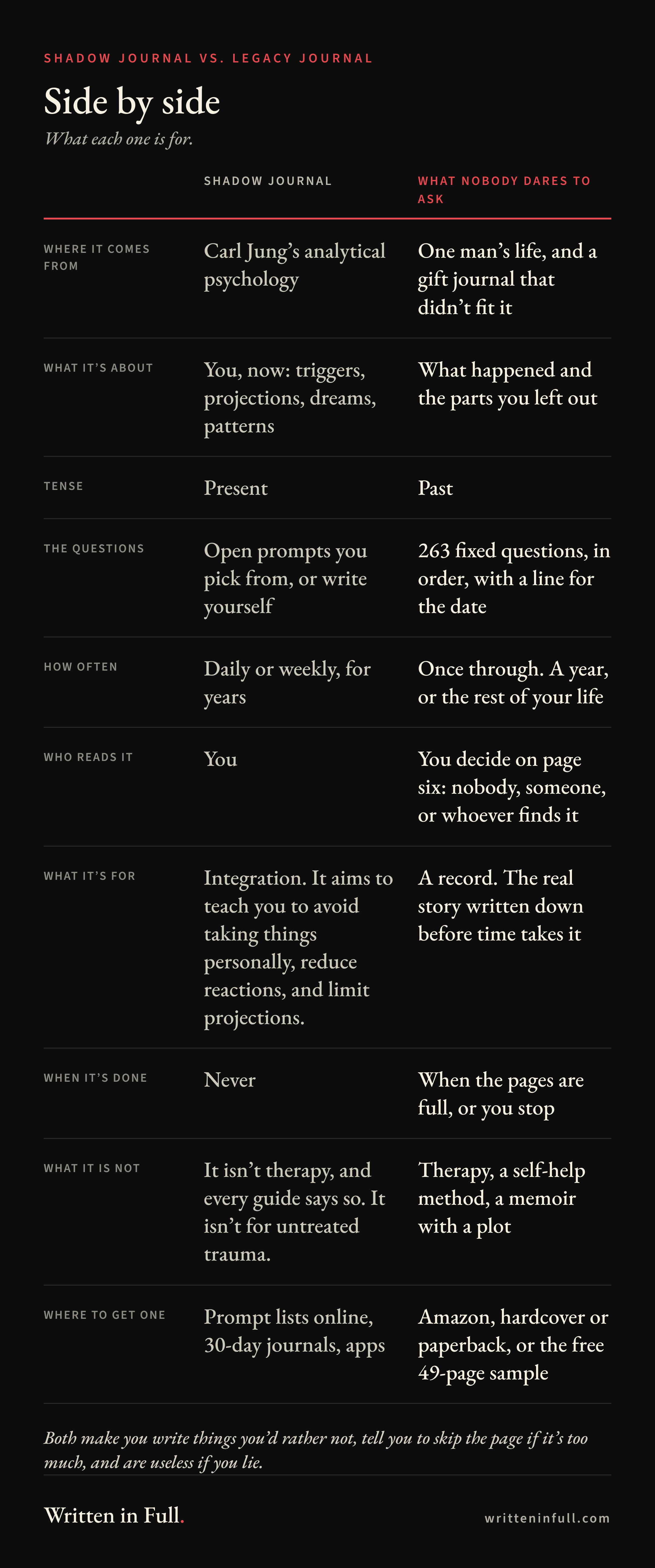
Both make you write things you’d rather not, tell you to skip the page if it’s too much, and are useless if you lie.
Which one you want
A shadow journal will teach you about yourself. If you want to stop taking things personally, keep one. I do, on and off.
Mine is for your children. If you want to prepare them for the difficult things, drug use, cheating partners, suicide, death, you write about it and you give it to them. You are their teacher. You can be there after you die. Health class will tell them what drugs to avoid. What drugs not to avoid, they can only get from you. Same with the marriage: why it broke down, so they recognise it when it starts happening in theirs. And if you ran away, or did time, or tried to kill yourself, they are going to hear about it at your funeral anyway, from someone who wasn’t there. That is what the 263 questions are for.
It will be difficult. We hide things from ourselves and from each other out of shame. The reward is that they get the unredacted version.
And if they build a chatbot of you when you’re gone, at least it won’t be the Instagram version.