Nobody buys their father a book that asks whether he ever cheated.
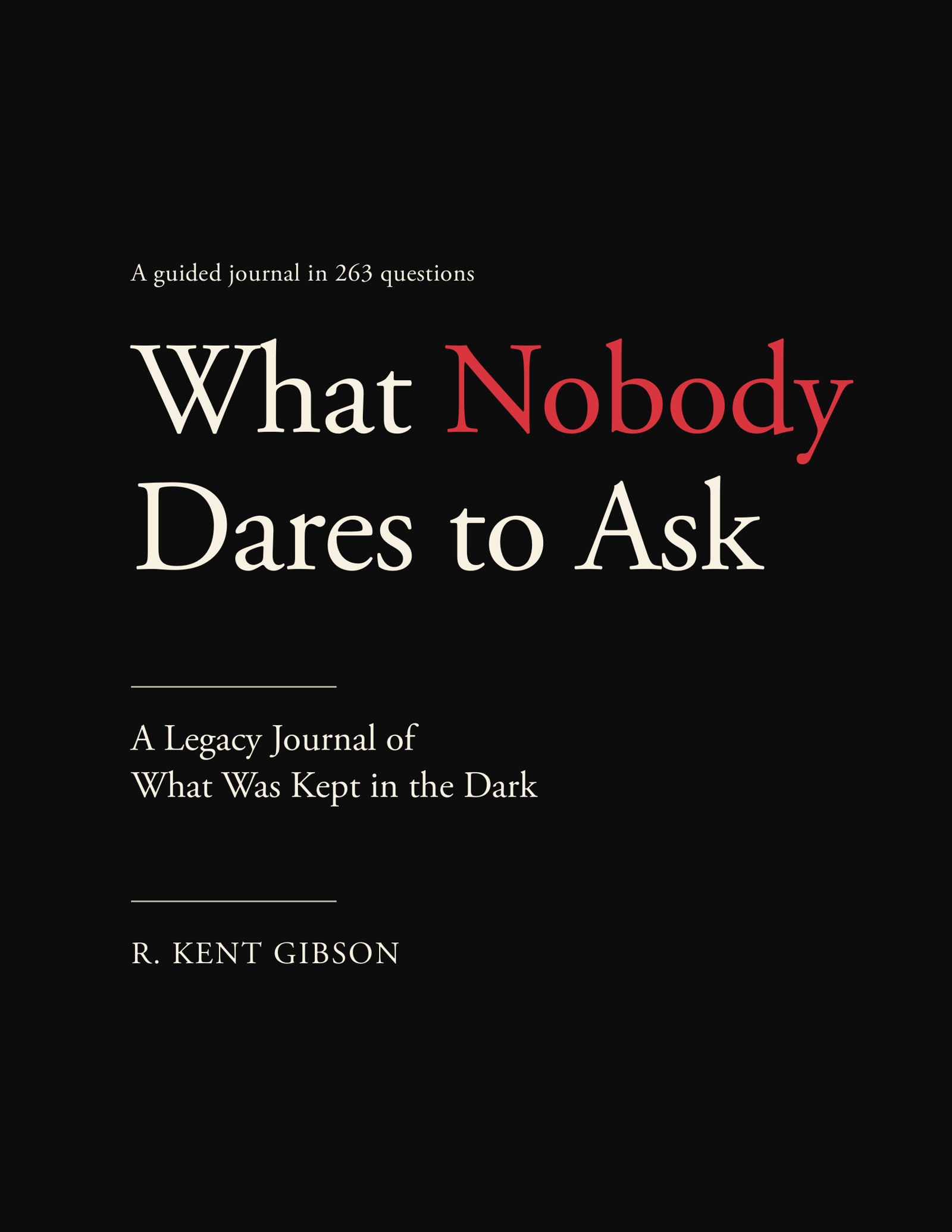
This is that book: a guided journal of 263 questions, with room to answer every one in your own hand and a date beside the answer.
Buy
Hardcover · 8.25 × 11 in · 206 pages, black on cream · ISBN 978-3-9526730-0-3
Buy on Amazon.com · Amazon.co.uk · Amazon.de
Paperback · 8.5 × 11 in · 206 pages, black on cream · ISBN 978-3-9526730-1-0
Buy on Amazon.com · Amazon.co.uk · Amazon.de
Printed on demand by Amazon. In Switzerland and the rest of the EU, buy on amazon.de. The hardcover is the keepsake; the paperback is the one to carry.
It is built so that it can be given. Skip whole sections. The heavy pages are marked before you reach them and carry a line at the foot saying where to find help. Page six asks whether the book should be burned, kept guarded, given away while you are alive, or left to be found, and you date your choice. Truth is invited here. It is never demanded.
Most legacy journals ask about your first bicycle. This one asks the questions families talk around for forty years: why you left, what you were frightened of, who hurt you, who you hurt, what you could not stop, and what you would do again. Who you would call at three in the morning. What the marriage was actually like on an ordinary Tuesday.
If you are already in the middle of the reckoning, sorting a parent’s house, holding a diagnosis, reaching the age your father was when he died, it was written for you first. Nobody has to hand it to you.
If you are giving it, page five is yours. You write why you gave it, and the person you gave it to reads that before anything else.
How this ends
Before the first question, the book asks what happens to it. You choose one, and write the date beside it:
- Burn it. A thing can be worth writing and not worth keeping.
- Keep it guarded, somewhere you would keep a will, and tell one person where.
- Give it away while you are alive, to one person, and be in the room.
- Leave it to be found, and accept that you will not be there to explain it.
Inside
- 263 questions in four parts: Beginnings, Patterns, Reckoning, Becoming
- A date beside every answer
- Three questions asked twice, early and near the end, so you can see what changed
- Lists after the heaviest pages, on purpose, after Sei Shōnagon’s pillow book
- Heavy pages marked, warned on the page before, and footed with where to find help
- A thematic index of every question
- A helpline directory for more than twenty countries
A few of the questions
When have you hurt someone physically, outside of self-defense?
What was never spoken about openly in your family?
What did they survive that you have never had to?
Who would you call at three in the morning?