Drug use, betrayal. You will confront them, confess them, or pass their damage on. Suicide, death. You will survive them, speak of them, or bury them.
It is hard to tell your children and grandchildren what you have been through.
Do you want them to face the same demons unprepared?
Go first so they don’t have to. Going first means telling your story honestly so your family can learn from it and start to heal.
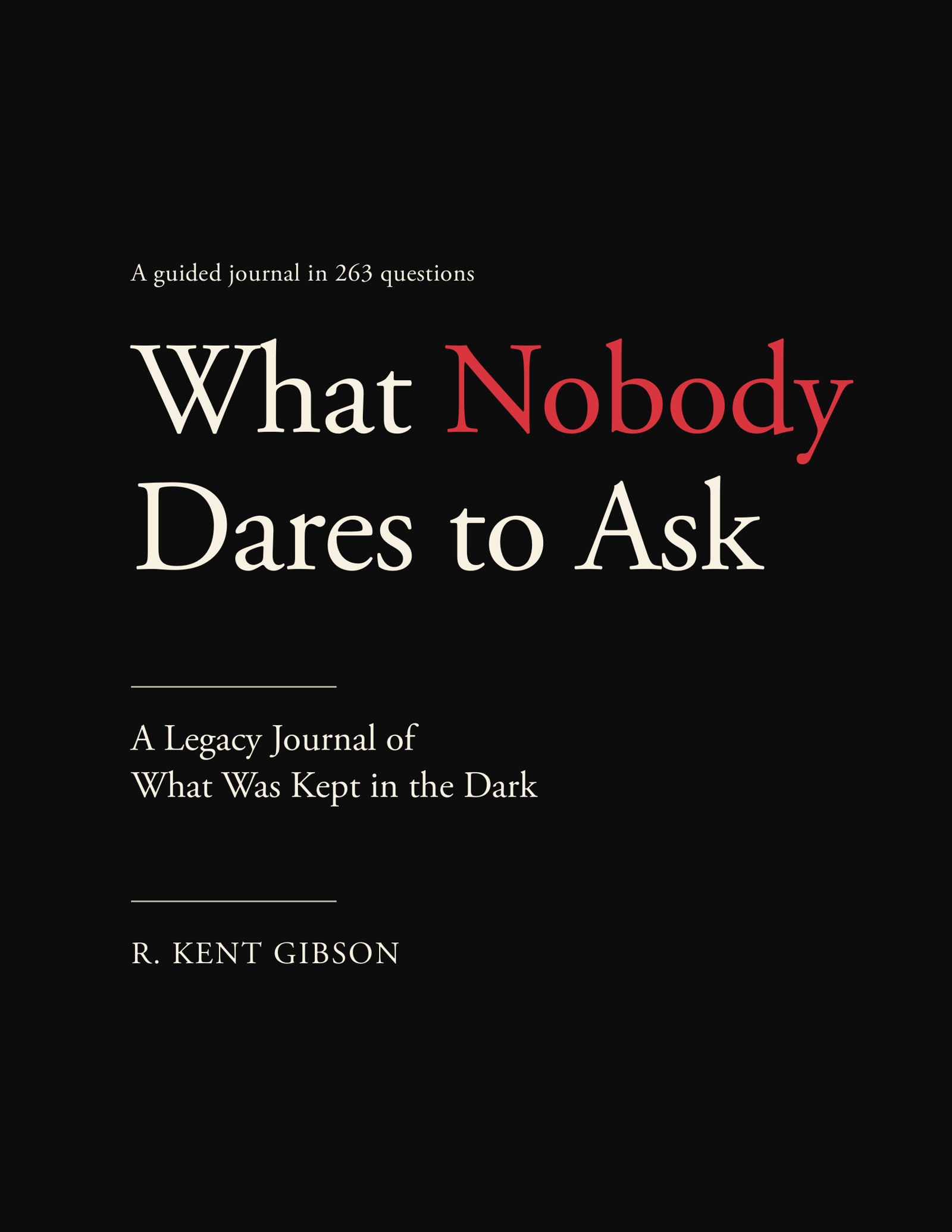
From the book What Nobody Dares to Ask: A Legacy Journal of What Was Kept in the Dark, by R. Kent Gibson.
263 questions about the years you don’t talk about.
Hardcover or paperback · 206 pages
Or pick up the free sample: 49 pages of the journal by email.
Follow along #WhatDidILeaveOut Instagram · YouTube · TikTok · Facebook
The lessons only you can give your children
You are their teacher, and you can still be there after you die.
Health class will tell them which drugs to steer well clear of. What drugs they should avoid they can only learn from you. The same applies to relationships. Why your relationship collapsed they can only find out from you. If you ran away, were in prison, attempted suicide etc then they may be the first to hear about it at your funeral (from someone who wasn’t there). They deserve a first hand account. Surviving it was one form of bravery. Telling them is another. That’s what the 263 questions are for.
It’s going to be hard. We hide things from ourselves and from each other out of shame. But telling the full truth isn’t about inflicting pain, it’s about healing the pain. Truth can be the very bedrock of a stronger relationship and the very act of facing the difficult things together can be a route to understanding and to closeness. The reward of this book is that they get the unredacted version. The most painful years of your life can be the most useful thing you ever give your children.
Don’t hand them your damage, hand them your challenges. Telling them what happened isn’t the same as handing them the damage. It’s just facing it.
My son gave me one of those “tell us your life story” journals. It was designed for people whose lives were easy to tell. Mine wasn’t, so I wrote the journal that I needed.
When I answered those questions myself, I thought the difficult bit would be remembering. It wasn’t. The hard part was deciding what to leave out.
A few of the 263 questions
- Who would you call at three in the morning? Read my answer →
- What is the cruelest thing that one of your parents ever said to you? Read my answer →
- What did you promise yourself you would never repeat? Read my answer →
- What apology are you still owed, and by whom? Read my answer →
- What was never spoken about openly in your family?
- What did they survive that you have never had to?
- What is something you experienced as a child that you have never told anyone? Read my answer →
- When have you hurt someone physically, outside of self-defense?
Start with the question that scares you the least. Sometimes starting with something gentle can help you get your feet under you before you go any further. Not sure where to start? Read The question you never asked.
In most families, nobody asks tough questions. Secrets get talked around for forty years, and then somebody dies, and the secrets go into the ground with them. Facts usually can be reconstructed. What cannot be recovered are the untold stories.
No-one buys their dad a book that asks whether he ever cheated.
No-one buys their mother a book that asks her what she gave up and whether she forgave her children for it.
No-one buys a book that asks you in what year you didn’t want to be alive.
So I wrote down the list of questions I wanted to be asked. They are not gentle.
What Nobody Dares to Ask
What Nobody Dares to Ask: A Legacy Journal of What Was Kept in the Dark is a legacy journal in four parts: Beginnings, Patterns, Reckoning and Becoming. There’s a ruled page to write your answer by hand and a line to date it. It’s all about what happened, what you left out and what demons you cast out. It’s intended to be a family relic, or ash. You decide.
When they’re old enough, let them read it or burn it. The book also asks what to do with it: lock it away with your will, leave it in the room and stay there, or just leave it to be found. When it’s about the right time to share the journal, think about whether your family is ready for that kind of honesty and whether you’re at all comfortable with them having your full story. Some people will wait until certain family members have reached a certain age or level of maturity, or until a particular moment of need or openness. You have to trust your own judgement as to when the time is right. I’ll give it to my son and it will be complete on the day I die.
I didn’t write any gentle ones. The heaviest pages are flagged a page ahead and each one has a helpline at the foot. You can actually skip entire sections.
Hardcover · 8.25 × 11 in (about 21 × 28 cm) · 206 pages — Amazon.com · Amazon.co.uk · Amazon.de
Paperback · 8.5 × 11 in (about 22 × 28 cm) · 206 pages — Amazon.com · Amazon.co.uk · Amazon.de
The hardcover is the keepsake. The paperback is the one to write in every day. More about the book
There are loads of journals out there for you. They’re all about self-discovery and finding patterns in yourself. A legacy journal is for you and your family. It’s about the mapping of generational trauma. You name the trauma.
Write it down so you don’t hand it down.
Take your time. It took me fifty years to get to the first question.
Free sample: the questions nobody dares to ask
A 49 page PDF of the journal, with the real questions and the actual helplines that go with the really difficult ones. Plus one question and my own answer most Mondays. E.g. “Who would you call at 3 in the morning?”
Confirm your email once and the download opens. Unsubscribe in one click. Never sold or shared. Privacy
This week’s question
-
Lies We Were Fed
What did you believe as a child that turned out not to be true? Content note: suicide.
Shadow journaling vs. a legacy journal: what each one is, and which one you want